
Decorative border

October 8, 2025

The Dutch Imbalance Market: Key Insights for Solar & Wind

Over the past 10 years in energy, I’ve seen markets, technologies and trading rules change faster than ever. These shifts bring both challenges and opportunities, which makes it useful to share practical lessons from the field. Let me begin with the Dutch imbalance market, which is evolving rapidly and will remain highly dynamic.

Why it’s important

For asset owners and traders imbalance has mostly been a risk. For renewable asset owners the imbalance mechanism turned into an opportunity over  the last years. Right now imbalance  poses  both a risk and an opportunity –  the imbalance state &  prices directly determine whether portfolio imbalance translates into costs or additional revenue.

What I’ve seen

  • Many new entrants, often with small assets
  • TenneT  joined the European PICASSO platform, influencing aFRR price formation.
  • TenneT, responding to rising dual-sided regulation (Regulation State 2), temporarily increased the delay in publishing data, such as the balance delta which is utilized by market parties to forecast imbalance settlement prices, from 2 to 5 minutes.
  • Despite the above measures, regulation state 2 has increased significantly since by 50%
  • TenneT reverting the intervention and instead started to tune the LFC dispatch algorithm

Bar chart that features percentage regulation state 2 (%) in the period 2023 - 2025. It shows that regulation state 2, set by TenneT, occurred equally often with a delay of 2 minutes as with 5 minutes.

What this means:

To compare “apples to apples,” let’s assume it is possible to make a perfect forecast of the imbalance price. In that case, you would know exactly when curtailment creates value. Even under this best-case scenario, the revenues from imbalance curtailment dropped a lot.

When comparing 2023/2024 with 2024/2025 for a strike price range of €0 to -€100/MWh, the market revenue went down sharply.

  • Solar imbalance curtailment value: DOWN 53-71%
  • Wind imbalance curtailment value: DOWN 44-63%

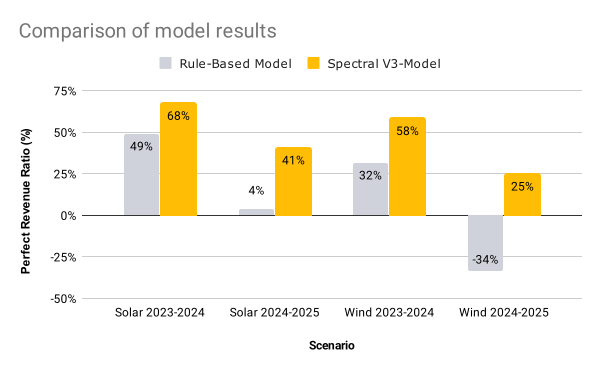
This highlights a critical challenge: forecasting models need to be upgraded to maximize revenues.  Rule-based curtailment strategies that performed well in 2023-2024 have seen diminishing or even negative returns as market dynamics shifted.

Our data analysis shows significant performance gaps between static rule-based control and advanced models.* 
Practical Takeaways

  • Therefore, forecasting models must evolve to keep up with rapidly changing market conditions.
  • Similarly, rule-based strategies should be reviewed—what worked last year may no longer deliver value.
  • Finally, track regulatory developments closely, as they significantly impact achievable revenues.

Coming Up

Imbalance curtailment is a start, but combining it with other markets can generate more value from your assets. In the next segment, I’ll walk you through how combining imbalance steering with strategies like day-ahead or intraday curtailment and providing aFRR, can help boost revenue while managing market price risks.


* Average attainable revenue ratio for wind and solar for strike prices -[0,20,40,60,80-100]. Our latest model achieves, on average, 41% of perfect revenues for solar and 25% for wind. The achievable revenues for a site depend heavily on the strike price, linked to the SDE-phase amount.
profile picture Spectral founder Philip Gladek

Questions? Contact us!

Philip Gladek

Founder & Chief Growth Officer

Get in touch
To use this functionality, you must first accept marketing cookies. Click here